
You press a single key, and the room suddenly vibrates with a raw, buzzing oscillator wave. It is just you, a patch cable, and the sheer unpredictability of an analog circuit.
Getting started with synthesis feels like learning to paint with electricity. These Best Beginner Synths turn that initial confusion into a creative playground. Pick one up, plug it in, and see where the sound takes you.
Key Takeaways
- Prioritize units with physical knobs or sliders over menu-heavy interfaces for immediate tactile feedback.
- Choose models with built-in sequencers if you want to compose complete ideas without needing an external computer.
- Ensure the keyboard size matches your available desk space, as compact units often prove more useful in cramped studio setups.
- Check if your chosen instrument offers patch memory so you can save your favorite sound designs for later use.
- Look for polyphonic capabilities if you plan to play chords, as monophonic synths are limited to one note at a time.
| Ultimate Entry Icon |  |
Stylophone Original Pocket Synthesizer | Simple tactile interface | Classic lo-fi sound | Extremely portable design | View on Amazon | Read Review |
| Vocoder Sound Engine |  |
Novation MiniNova Analog Modeling Synth | Powerful internal vocoder | Versatile sound engine | Compact desktop size | View on Amazon | Read Review |
| Portable Sequencing Powerhouse |  |
Roland AIRA Compact S-1 Synth | Deep 64-step sequencer | Highly portable | Unique motion control | View on Amazon | Read Review |
| Experimental Patch Canvas |  |
Moog Labyrinth Parallel Generative Synth | Unique generative sequencing | Dual oscillator design | Flexible patch bay | View on Amazon | Read Review |
| All-In-One Keyboard |  |
Akai MPK Mini Play MK3 | Built-in speaker | Includes software suite | Responsive drum pads | View on Amazon | Read Review |
| Creative Texture Explorer | 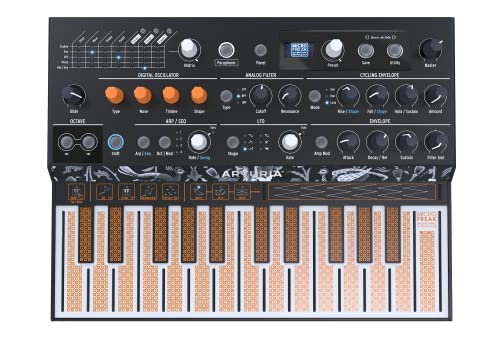 |
Arturia MicroFreak Hybrid Synthesizer | Versatile wavetable synthesis | Unique touch keyboard | Compact and lightweight | View on Amazon | Read Review |
| Software Production Essential |  |
Akai MPK Mini MK3 Controller | Great software integration | Sturdy drum pads | Highly portable | View on Amazon | Read Review |
| Classic Lead Machine |  |
Moog Messenger Monophonic Synthesizer | Iconic analog sound | Easy to use sequencer | Generous preset storage | View on Amazon | Read Review |
| Deep Synthesis Engine |  |
Arturia MiniFreak Hybrid Polyphonic Synth | Six-voice polyphony | Two powerful sound engines | High-quality effects | View on Amazon | Read Review |
| Experimental Noise Box |  |
Korg Monotron Delay Ribbon Synth | Addictive analog delay | Extremely portable | Fun ribbon controller | View on Amazon | Read Review |
More Details on Our Top Picks
-
Stylophone Original Pocket Synthesizer
If you want to understand the basic mechanics of synthesis without a steep learning curve, start here. This device acts like a musical toy that teaches you how sound changes when you slide a stylus across a keyboard. It is simple, tactile, and surprisingly addictive.
The sound is distinctly lo-fi and retro, making it a great creative tool for adding quirky textures to your tracks. Because it lacks complex menus, you will never get lost in sub-pages. Just be aware that the keyboard is not touch-sensitive, which limits your ability to add dynamic expression to your playing.
- Brand:Stylophone
- Type:Pocket Analog Synth
- Additional Feature:Built-in speaker
- Additional Feature:Stylus control
- Additional Feature:Battery operation
-
Novation MiniNova Analog Modeling Synth
This synth is built for the producer who wants massive, complex patches in a small footprint. With its powerful vocoder, you can process your own voice into robotic textures or shimmering leads. It is a workhorse for anyone interested in modern electronic design.
The interface is dense, so you should expect to spend some time learning how to manage the menus. While the keys are small, the deep editing potential makes up for the physical size. It fits well in a small studio where space is at a premium but sound quality cannot be sacrificed.
- Brand:Novation
- Type:Analog Modeling
- Key Count:37 Mini Keys
- Voice Count:18-Voice
- Connectivity:USB
- Additional Feature:Built-in effects per voice
- Additional Feature:Animate buttons
- Additional Feature:256 factory presets
-
Roland AIRA Compact S-1 Synth
This little box captures the spirit of classic Roland gear in a palm-sized chassis. It excels at quick, creative sound design because of its hands-on knobs and simple architecture. You can easily build complex rhythmic patterns using the integrated 64-step sequencer.
The D-Motion sensor adds a physical way to twist your sounds, which is a rare treat for a device this small. It is a fantastic choice if you want to sketch out ideas while traveling. Just remember that the tiny buttons require a bit of patience if you have larger hands.
- Brand:Roland
- Type:Polysynth
- Voice Count:4-Voice
- Power Source:Battery
- Connectivity:USB-C
- Additional Feature:D-Motion sound control
- Additional Feature:Osc draw and chop
- Additional Feature:MIDI compatibility
-
Moog Labyrinth Parallel Generative Synth
Designed for the adventurous musician, this synth uses generative sequencing to create evolving, organic sounds. It acts like an unruly garden that you slowly learn to prune and shape. If you enjoy abstract soundscapes rather than traditional keyboard playing, you will find this instrument incredibly rewarding.
Because it uses a semi-modular design, you can ignore the patch bay at first to learn the basics. Eventually, you will want to plug in cables to discover hidden harmonic relationships. It is not a standard instrument, but rather a machine for exploring the edges of sound.
- Brand:Moog
- Type:Semi-Modular Analog
- Voice Count:Dual Oscillators
- Additional Feature:VC wavefolder
- Additional Feature:VC filter
- Additional Feature:Dual sequencer
-
Akai MPK Mini Play MK3
You get a controller, a sound library, and a speaker all in one unit here. It is the perfect companion for a beginner producer who wants to start making music the moment they open the box. The integrated speaker means you do not even need to connect to a computer to start jamming.
The keys are responsive enough for basic melodies, and the drum pads feel sturdy under your fingers. While the internal sounds are meant for practice, they provide a solid foundation for learning rhythm and harmony. It is a practical tool for keeping the creative momentum going anywhere.
- Brand:Akai
- Type:MIDI Controller
- Key Count:25 Keys
- Additional Feature:Native Instruments sound package
- Additional Feature:Dynamic keybed
- Additional Feature:Portable battery power
-
Arturia MicroFreak Hybrid Synthesizer
The MicroFreak is a playground for anyone who wants to move beyond traditional subtractive synthesis. With its digital oscillator and analog filter, you can create sounds that are jagged, metallic, or incredibly lush. The touch-sensitive keyboard is a unique interface that encourages a different approach to melody.
It offers vast sonic variety, making it difficult to get bored with your own patches. You will need to get used to the non-moving keys, as they do not feel like a standard piano. Once you adjust, the polyphonic aftertouch provides a level of expression that is rare at this level.
- Brand:Arturia
- Type:Hybrid Synth
- Key Count:25-Key
- Additional Feature:Polyphonic aftertouch
- Additional Feature:Analog filters
- Additional Feature:Multi-mode oscillators
-
Akai MPK Mini MK3 Controller
This is the standard for anyone looking to control virtual instruments inside a digital recording studio. It strips away the internal sounds to focus entirely on precision and connectivity. The backlit drum pads are excellent for programming beats and triggering samples with ease.
It is small enough to slide into a backpack, yet it feels durable enough for daily use. You will appreciate how well it integrates with standard software programs. If you already have a computer full of sounds, this provides the tactile control you need to make them come alive.
- Brand:Akai
- Type:MIDI Controller
- Key Count:25-Key
- Connectivity:USB
- Additional Feature:Native Instruments NKS integration
- Additional Feature:Assignable knobs
- Additional Feature:Included production software
-
Moog Messenger Monophonic Synthesizer
This synth brings the legendary Moog sound into a modern, feature-rich package. It is a monophonic powerhouse, which means it is designed for cutting through a mix with thick, punchy bass lines or soaring leads. The built-in sequencer allows you to program complex lines that loop perfectly.
The interface is intuitive, focusing on hands-on control rather than burying options in menus. You can save your creations to the 256 preset slots, which is a massive help for live performance. It is a reliable, high-quality instrument that grows with your skills.
- Brand:Moog
- Type:Monophonic Analog
- Key Count:32 Keys
- Voice Count:Monophonic
- Additional Feature:64-step sequencer
- Additional Feature:Res bass compensation
- Additional Feature:256 preset slots
-
Arturia MiniFreak Hybrid Polyphonic Synth
Expanding on the original, this version adds more voices and a full-sized keyboard for better playability. It functions like a massive digital lab, giving you two engines to blend and modulate sounds into something entirely new. The six-voice polyphony allows you to play chords and complex arrangements with ease.
It is a serious instrument that invites deep exploration without being intimidating. With the included effects, you can finish your patches without needing external gear. The slim velocity keys feel significantly more professional than smaller alternatives, making this a great choice for long sessions.
- Brand:Arturia
- Type:Hybrid Synth
- Key Count:37 Slim Keys
- Voice Count:6-Voice
- Additional Feature:64-step sequencer
- Additional Feature:SVF filter
- Additional Feature:Aftertouch support
-
Korg Monotron Delay Ribbon Synth
This is the ultimate tool for someone who enjoys the chaos of sound. It uses a ribbon controller instead of keys, allowing you to slide between notes with total freedom. The analog delay circuit adds a thick, swirling quality that makes even simple noises sound like a science fiction movie.
It is incredibly small, making it a fun device to keep on your desk for a quick burst of inspiration. Do not expect to play traditional piano pieces on it, as the ribbon is built for wild manipulation. It is an affordable way to introduce yourself to the magic of analog feedback loops.
- Brand:Korg
- Type:Ribbon Analog
- Power Source:Battery
- Additional Feature:Built-in speaker
- Additional Feature:External input jack
- Additional Feature:Simple knob interface
Frequently Asked Questions
Do I need an external amplifier to hear my synth?
Most synthesizers have a headphone output for private practice. If you want to play out loud, you should plug the line-out into a dedicated keyboard amp or a pair of powered studio monitors.
What is the difference between a synth and a MIDI controller?
A synth generates its own sound using internal processors. A MIDI controller has no internal sound engine and only sends data to your computer to trigger virtual instruments.
Is it hard to learn sound design from scratch?
Every synth has a learning curve, but most modern beginner models include clear labels and intuitive signal paths. Start by tweaking existing presets to see how filter adjustments change the tone.
Can I record my synth directly into a computer?
You will need an audio interface to convert the analog signal from your synth into a digital format your computer understands. Simply plug the quarter-inch cables from the synth output into the interface input.
Should I buy a monophonic or polyphonic synth first?
A polyphonic synth is generally better for beginners because it allows you to play chords and melodies. Monophonic synths are limited to one note at a time, making them better suited for basslines or lead solos.