
Many musicians start by buying the most complex keyboard they can afford, only to realize the interface is a maze of confusion. You should prioritize an instrument that encourages immediate creative feedback rather than one that requires an advanced degree to operate.
These Best Synths for Beginners strip away the unnecessary clutter. They focus on clear signal paths and tactile controls that teach you the foundations of sound design. Here are the units that actually make sense for your first setup.
Key Takeaways
- Prioritize models with a dedicated knob for every primary function to avoid hidden menu systems.
- Select a keyboard size that fits your desk, but ensure the keys feel responsive enough for basic technique.
- Check if the instrument includes built-in speakers for instant jamming without needing external monitors.
- Look for tactile synthesis engines that provide physical feedback as you shape your sound.
- Confirm the presence of standard output jacks if you plan to record your progress into a computer.
| Breath Controlled Exploration |  |
Vangoa EWI-100 Digital Wind Instrument | Natural breath control | Lightweight design | Easy maintenance | View on Amazon | Read Review |
| Retro Analog Charm |  |
Stylophone Original Pocket Synthesizer | Iconic retro aesthetic | Simple stylus interface | Highly portable | View on Amazon | Read Review |
| Experimental DIY Fun |  |
MicroKits Synth-a-Sette Analog Synthesizer | Ultra compact size | Conductive surface play | DIY learning potential | View on Amazon | Read Review |
| Powerful Micro Polysynth |  |
Roland AIRA Compact S-1 Tweak Synth | Advanced sound design | Compact yet capable | Expressive motion control | View on Amazon | Read Review |
| Versatile Analog Discovery |  |
Stylophone GENX-2 Portable Analogue Synthesizer | Proper analog filter | CV and Gate connectivity | Built-in delay effects | View on Amazon | Read Review |
| All-In-One Production |  |
Akai MPK Mini Play MK3 Controller | Velocity sensitive keys | Integrated sound library | Portable speaker included | View on Amazon | Read Review |
| Deep Digital Synthesis |  |
Portable FM Synthesizer with Arpeggiator | Extensive FM engine | Clear visual display | Built-in sequencer | View on Amazon | Read Review |
| Affordable Studio Foundation |  |
M-VAVE 25 Key MIDI Controller | Bluetooth wireless support | Semi-weighted keybed | Backlit drum pads | View on Amazon | Read Review |
| Unconventional Sound Explorer | 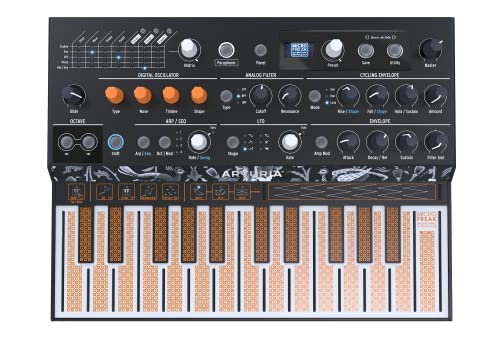 |
Arturia MicroFreak Paraphonic Synthesizer | Polyphonic aftertouch keys | Diverse oscillator modes | CV and gate inputs | View on Amazon | Read Review |
| Software Integration Expert | 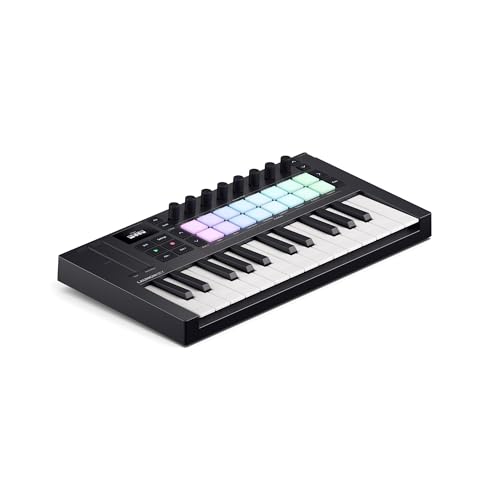 |
Novation Launchkey Mini MK4 Controller | Deep DAW integration | Polyphonic aftertouch pads | Integrated OLED screen | View on Amazon | Read Review |
More Details on Our Top Picks
-
Vangoa EWI-100 Digital Wind Instrument
If you are coming from a woodwind background, this instrument bridges the gap to electronic synthesis. It offers a tactile playing experience that feels more organic than tapping on plastic keys.
The device is lightweight and includes a removable mouthpiece, making it easy to keep clean. While the internal speaker is functional for practice, you should connect it to an amplifier to hear the full depth of the sound engine.
- Brand:Vangoa
- Instrument Type:Digital wind synthesizer
- Power Source:Rechargeable battery
- Connection Type:Wireless and USB
- Additional Feature:Multiple built-in tones
- Additional Feature:Removable mouthpiece
- Additional Feature:Portable chassis
-
Stylophone Original Pocket Synthesizer
This classic synth is an entry-level icon that uses a stylus instead of a traditional keyboard. It produces a distinct, buzzing tone that sounds like a vintage sci-fi soundtrack, perfect for those who want immediate, quirky gratification.
The interface is incredibly simple, with just a few switches and a tuning knob. You will find it lacks the depth of modern workstations, but its charming simplicity is exactly the point.
- Brand:Stylophone
- Instrument Type:Analog synthesizer
- Power Source:Batteries
- Connection Type:Headphone output
- Additional Feature:Built-in speaker
- Additional Feature:Vibrato switch
- Additional Feature:Stylus control
-
MicroKits Synth-a-Sette Analog Synthesizer
Small enough to fit in a pocket, this synth appeals to those who enjoy building and tinkering. It allows you to play melodies on the go, but the real magic happens when you use the conductivity features to turn everyday objects into custom keys.
The design is clearly aimed at hobbyists who want a hands-on lesson in how analog circuits function. Just keep in mind that the form factor is quite delicate, so it requires a gentle touch during assembly and use.
- Brand:MicroKits
- Instrument Type:Analog synthesizer
- Form Factor:Cassette sized
- Additional Feature:Banana keyboard support
- Additional Feature:Pocket portability
- Additional Feature:Analog sound engine
-
Roland AIRA Compact S-1 Tweak Synth
This unit packs a surprising amount of punch into a tiny footprint. It is ideal for musicians who want to shape their own sounds, offering deep control over waveforms and envelopes for complex textures.
The D-Motion control lets you manipulate sounds physically, which adds an expressive layer to your performances. It is a sophisticated piece of gear that rewards those who spend time learning its menu structure.
- Brand:Roland
- Instrument Type:Polysynth
- Power Source:USB battery
- Connection Type:USB and MIDI
- Additional Feature:D-Motion sound modulation
- Additional Feature:Onboard sequencer
- Additional Feature:Portable form factor
-
Stylophone GENX-2 Portable Analogue Synthesizer
Stepping up from the original, this version adds real sound-shaping tools like an LFO and filter. It is an excellent choice for a beginner who wants to understand subtractive synthesis without getting buried in complex digital menus.
The inclusion of CV and Gate outputs means you can hook it up to other modular gear as your setup grows. While it retains the stylus interface, the audio quality is significantly more robust than the entry-level model.
- Brand:Stylophone
- Instrument Type:Analog synthesizer
- Power Source:Battery
- Connection Type:CV and Gate
- Additional Feature:Analog delay effect
- Additional Feature:Built-in speaker
- Additional Feature:LFO modulation
-
Akai MPK Mini Play MK3 Controller
If you want a device that works as both a controller and a standalone instrument, this is your best bet. It features velocity-sensitive keys that feel responsive and a set of pads that make drum programming intuitive.
The built-in speaker means you can sketch out ideas anywhere without opening a laptop. It is a complete creative hub for someone who values workflow and speed.
- Brand:Akai Professional
- Instrument Type:MIDI Keyboard Controller
- Key Count:25
- Power Source:USB or battery
- Connection Type:USB
- Additional Feature:8 MPC pads
- Additional Feature:Built-in sounds
- Additional Feature:Included software suite
-
Portable FM Synthesizer with Arpeggiator
For those who prefer the crystalline, glassy sounds of FM synthesis, this unit is a goldmine. It offers 32 algorithms and six operators, providing a deep palette for anyone interested in complex sound design.
The TFT display screen makes it much easier to manage your patches than traditional button-only interfaces. It is a dense, high-functioning instrument that demands a bit of patience to master.
- Brand:Generic
- Instrument Type:FM Synthesizer
- Power Source:Battery
- Connection Type:USB
- Additional Feature:Arpeggiator
- Additional Feature:16-step sequencer
- Additional Feature:Six operators
-
M-VAVE 25 Key MIDI Controller
This controller focuses on the essentials, providing a reliable keyboard for software-based music making. The semi-weighted keys provide a better feel than most budget options, making it easier to play with proper dynamics.
With Bluetooth connectivity, it is a great choice if you prefer a cable-free workspace. It is a straightforward tool that does exactly what it promises without unnecessary distractions.
- Brand:M-VAVE
- Instrument Type:MIDI Keyboard Controller
- Key Count:25
- Connection Type:Bluetooth and USB
- Additional Feature:8 assignable knobs
- Additional Feature:Included music software
- Additional Feature:Dynamic keybed
-
Arturia MicroFreak Paraphonic Synthesizer
This synth is a playground for the curious mind, blending digital oscillators with an analog filter. Its unique touch-sensitive keybed allows for polyphonic aftertouch, which is a rare and powerful feature at this level.
The paraphonic architecture lets you play chords that evolve and shift as you tweak the knobs. It is a must-have if you want a sound that is truly distinct from standard subtractive synths.
- Brand:Arturia
- Instrument Type:Digital hybrid synthesizer
- Key Count:25
- Power Source:Power adapter
- Connection Type:USB and MIDI
- Additional Feature:Paraphonic mode
- Additional Feature:Modulation matrix
- Additional Feature:Touch interface
-
Novation Launchkey Mini MK4 Controller
Built primarily for those working with digital audio workstations, this controller makes music production feel like second nature. The polyphonic aftertouch pads give you a high degree of expression when triggering samples or drum hits.
The OLED display is a significant upgrade, offering clear feedback on your settings while you focus on the music. It is a polished, reliable bridge between your imagination and your software.
- Brand:Novation
- Instrument Type:MIDI Keyboard Controller
- Key Count:25
- Power Source:USB
- Connection Type:USB
- Additional Feature:Scale and chord modes
- Additional Feature:Arpeggiator
- Additional Feature:MIDI output
Frequently Asked Questions
Do I need to learn piano theory to play a synthesizer?
You do not need formal training, but knowing basic music theory helps immensely. Understanding how scales and chords work will make your sound design sessions much more productive. Think of theory as the map that keeps you from getting lost in a forest of knobs.
Is an analog synth better for a first-time buyer?
Analog gear is rewarding, but it often lacks patch memory, making it difficult to replicate your favorite sounds later. Digital options are usually more stable and offer a broader sonic palette for the price. Start digital if you want immediate results without the technical maintenance.
What is a DAW and do I need one?
A DAW, or Digital Audio Workstation, is the software you use to record and arrange your music. You do not strictly need one to practice, but it is essential if you want to capture your ideas. Most modern synthesizers integrate with these programs to act as your primary studio hub.
Are built-in speakers necessary?
Most professional-grade synthesizers do not include speakers, as they are meant to be plugged into an external sound system. If you want a portable unit for the couch, look for a model with integrated monitoring. Otherwise, budget for a decent set of headphones or studio monitors.
How much should I spend on my first synth?
You can find capable instruments in the $300 to $600 range. Avoid the absolute cheapest options, as they often have flimsy build quality and limited features. Investing in a mid-range piece ensures you have a tool you won't outgrow in six months.