
Synthesizers once lived in massive wooden cabinets that demanded an entire room and a small fortune. Today, these instruments have shrunk into portable tools that fit inside a backpack.
Finding the Best Synthesizers for Beginners no longer requires a degree in electrical engineering. Modern hardware bridges the gap between raw potential and intuitive playability, allowing you to start making music the moment you plug in.
Key Takeaways
- Focus on keys that offer consistent velocity sensitivity to ensure your performances sound expressive and dynamic.
- Prioritize controllers that provide deep integration with your preferred digital audio workstation to save time during setup.
- Choose a model with built-in sounds if you want to perform without relying on a computer.
- Look for polyphony counts that allow you to play chords rather than just single lead notes.
- Verify that the physical inputs like MIDI and CV ports match the other gear in your current studio.
| Best Overall Value |  |
Behringer Phara-o Mini Compact Synthesizer | Extremely compact footprint | Intuitive knob layout | Authentic analog character | View on Amazon | Read Review |
| All-In-One Studio |  |
Akai MPK Mini Play MK3 Controller | Integrated speaker system | Responsive dynamic keybed | Portable standalone operation | View on Amazon | Read Review |
| Top Production Utility |  |
Akai MPK Mini MK3 Keyboard Controller | Reliable software integration | Excellent pad sensitivity | Compact and durable | View on Amazon | Read Review |
| Advanced Hybrid Power |  |
Arturia MiniFreak 37 Key Hybrid Synthesizer | Dual digital engines | Expressive keybed | Built-in effects processing | View on Amazon | Read Review |
| Charming Budget Entry |  |
Stylophone Original Pocket Synthesizer | Fun stylus interface | Highly portable size | Very affordable | View on Amazon | Read Review |
| Best Feature Set |  |
Akai MPK Mini Plus Controller | Expanded 37-key range | Hardware CV connectivity | Integrated sequencer | View on Amazon | Read Review |
| Most Creative Synthesis | 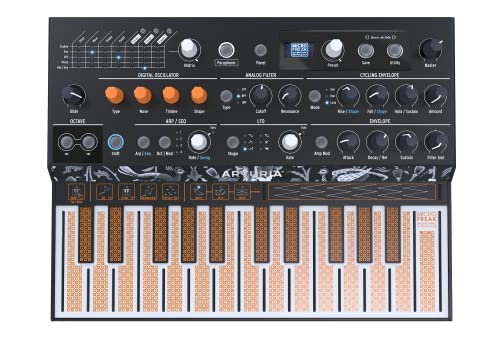 |
Arturia MicroFreak Hybrid Synthesizer | Deep digital oscillators | Versatile filter modes | Touch-sensitive keybed | View on Amazon | Read Review |
| Best Learning Companion |  |
Donner DMK 25 Pro Controller | Integrated smart scales | Includes teaching courses | OLED display | View on Amazon | Read Review |
| Simplest Travel Option |  |
Akai LPK25 MIDI Keyboard Controller | Extremely lightweight | Responsive synth keys | Minimalist design | View on Amazon | Read Review |
| FL Studio Specialist |  |
Novation FLkey 2 Mini Controller | Deep FL Studio integration | Dedicated clip launching | Portable form factor | View on Amazon | Read Review |
More Details on Our Top Picks
-
Behringer Phara-o Mini Compact Synthesizer
This compact unit acts like a focused laboratory for sound design. If you want to build custom tones without getting lost in a labyrinth of menus, this is your starting point. It provides enough tactile control to keep you engaged while remaining small enough to fit on a crowded desk.
You might find the limited interface challenging if you prefer deep parameter editing. It favors direct, hands-on sound creation over complex digital routing. It is the perfect choice for a beginner who wants to generate raw, analog-style textures immediately.
- Brand:Behringer
- Instrument Type:Mini Synthesizer
- Product Series:Phara-o
- Additional Feature:High quality sound engine
- Additional Feature:Rugged build construction
- Additional Feature:Portable design
-
Akai MPK Mini Play MK3 Controller
When you need a self-contained instrument, the MPK Mini Play shines. Because it includes a built-in speaker and internal sounds, you can play anywhere without booting up your computer. Think of it as a musical sketchbook that lives in your backpack.
The dynamic keybed offers a natural response for melodic lines. While the built-in speaker is convenient for quick ideas, you should connect it to external monitors or headphones for serious production work.
- Brand:Akai Professional
- Instrument Type:MIDI Keyboard Controller
- Key Count:25 keys
- Power Source:USB or batteries
- Software Included:MPC Beats
- Product Series:MPK Mini
- Additional Feature:Hundreds of internal sounds
- Additional Feature:Backlit drum pads
- Additional Feature:Battery powered portability
-
Akai MPK Mini MK3 Keyboard Controller
This controller is the industry standard for home beat makers. It strips away the internal speakers found in other models to focus entirely on controlling your digital audio workstation. You get a reliable, high-quality interface that integrates well with most software.
The eight backlit drum pads provide a satisfying tactile feel for laying down percussion. It lacks internal sounds, so it is strictly a tool for triggering software instruments on your computer.
- Brand:Akai Professional
- Instrument Type:MIDI Keyboard Controller
- Key Count:25 keys
- Power Source:USB
- Software Included:MPC Beats
- Product Series:MPK Mini
- Additional Feature:Arpeggiator included
- Additional Feature:Eight assignable knobs
- Additional Feature:OLED display screen
-
Arturia MiniFreak 37 Key Hybrid Synthesizer
The MiniFreak is a sonic powerhouse that bridges the gap between digital versatility and analog warmth. With two sound engines and a lush filter, you can craft sounds that range from ethereal pads to aggressive leads. It is a fantastic choice if you want to grow as a sound designer.
The slim keys include aftertouch support, which adds an expressive layer to your performances. Its complexity might feel daunting at first, but the layout remains logical for those willing to learn.
- Brand:Arturia
- Instrument Type:Hybrid Synthesizer
- Key Count:37 keys
- Product Series:MiniFreak
- Additional Feature:64-step sequencer
- Additional Feature:Multiple analog filters
- Additional Feature:Polyphonic aftertouch
-
Stylophone Original Pocket Synthesizer
Playing the Stylophone feels like using a retro science project. Its unique stylus-based interface creates a distinct, buzzing tone that sounds like nothing else on the market. It is an affordable entry point for anyone curious about electronic music.
You will not find complex features or MIDI connectivity here. It serves as a quirky melodic tool rather than a professional production centerpiece.
- Brand:Stylophone
- Instrument Type:Pocket Synthesizer
- Additional Feature:Battery powered
- Additional Feature:Vintage sound aesthetic
- Additional Feature:Integrated speaker
-
Akai MPK Mini Plus Controller
If you need extra room to play, the 37-key layout offers a wider range than standard mini controllers. This model adds a dedicated sequencer and CV connectivity, turning it into a command center for your entire desktop setup. It acts like a bridge between your computer and external hardware gear.
The added I/O options provide significant creative flexibility for the future. It is physically larger than the classic MPK Mini, so check your desk space before committing to the extra keys.
- Brand:Akai Professional
- Instrument Type:MIDI Keyboard Controller
- Key Count:37 keys
- Power Source:USB
- Software Included:MPC Beats
- Product Series:MPK Mini
- Additional Feature:MIDI/CV/Gate I/O
- Additional Feature:Eight MPC pads
- Additional Feature:Transport controls
-
Arturia MicroFreak Hybrid Synthesizer
The MicroFreak is a wild experimental instrument that encourages you to break traditional rules. Its touch-sensitive keyboard and deep digital oscillators allow for textures that are impossible to find on standard synthesizers. It is a bold choice for an ambitious beginner.
The PCB-style keyboard requires a different playing style compared to traditional keys. Once you adapt to its unique tactile feedback, it becomes an endless fountain of inspiration.
- Brand:Arturia
- Instrument Type:Hybrid Synthesizer
- Key Count:25 keys
- Product Series:MicroFreak
- Additional Feature:Polyphonic aftertouch
- Additional Feature:Modulation matrix
- Additional Feature:Wavetable synthesis
-
Donner DMK 25 Pro Controller
This controller is built specifically to help you master music theory. With its built-in smart scales and teaching courses, it functions as both a MIDI interface and a tutor. It is an ideal starting point if you are new to the world of music production.
The OLED display provides helpful visual feedback during your sessions. While it aims to teach, you will eventually outgrow the training features as your skills improve.
- Brand:Donner
- Instrument Type:MIDI Keyboard Controller
- Key Count:25 keys
- Power Source:USB-C
- Software Included:DAW suite
- Product Series:DMK
- Additional Feature:Arpeggiator function
- Additional Feature:Eight drum pads
- Additional Feature:Portable design
-
Akai LPK25 MIDI Keyboard Controller
The LPK25 is the minimalist choice for someone who just needs a keyboard. It skips all the extra knobs, sliders, and screens to provide a pure, no-nonsense playing experience. It is small enough to slide into a laptop sleeve without a second thought.
Its simplicity is its greatest strength, though it lacks the deep control options found in more complex units. This is for the player who wants to keep their focus entirely on the notes.
- Brand:Akai Professional
- Instrument Type:MIDI Keyboard Controller
- Key Count:25 keys
- Power Source:USB
- Product Series:LPK
- Additional Feature:Built-in arpeggiator
- Additional Feature:Plug and play
- Additional Feature:Sustain pedal input
-
Novation FLkey 2 Mini Controller
If you rely on FL Studio, this keyboard is your dedicated partner. It maps directly to the software functions, allowing you to trigger clips and navigate your project without touching the mouse. It is like having a remote control for your creative process.
The integration is so deep that it works best when paired specifically with that software. It remains a capable controller for other apps, but you will miss out on the deep mapping features.
- Brand:Novation
- Instrument Type:MIDI Keyboard Controller
- Key Count:25 keys
- Power Source:USB
- Software Included:FL Studio trial
- Product Series:FLkey
- Additional Feature:Built-in arpeggiator
- Additional Feature:Pitch and mod strips
- Additional Feature:16 drum pads
Frequently Asked Questions
Do I need to know how to play piano to use a synthesizer?
You do not need formal training to start. Many producers use synthesizers to create rhythmic patterns or soundscapes that do not require traditional keyboard skills. Learning basic scales will make your life easier, but the synth is a playground rather than a classroom. You can use built-in sequencers to trigger notes automatically while you focus on twisting knobs.
What is the difference between analog and digital synthesizers?
Analog synths use physical electrical circuits to create sounds, resulting in a warm, unpredictable character. Digital synths use computer code to mimic these sounds or create entirely new textures. Digital models are usually more versatile and affordable for beginners. Analog gear is often more expensive and requires more manual tuning to keep stable.
Can I use a synthesizer as a MIDI controller?
Yes, almost every modern synthesizer doubles as a MIDI controller. You can connect it to your computer via USB to control virtual instruments inside your music software. This gives you the best of both worlds. You get a dedicated hardware instrument for your desk and a keyboard to play the software sounds you already own.
How do I store and save my own sounds?
Most modern synthesizers have internal memory slots to save your custom patches. Once you design a sound you enjoy, you simply press a save button to recall it later. Some entry-level analog synths lack this feature, meaning you must write down your knob settings on paper. Digital units almost always include digital storage, which is much more convenient for beginners.
Is it better to buy a hardware synth or use software?
Software plugins are cheap and offer thousands of sounds at a click. However, hardware provides a physical interface that helps you learn how sound actually works. Hardware removes the distraction of a computer screen, helping you focus entirely on your music. If you find yourself staring at your monitor for too long, a physical synth is a refreshing change of pace.